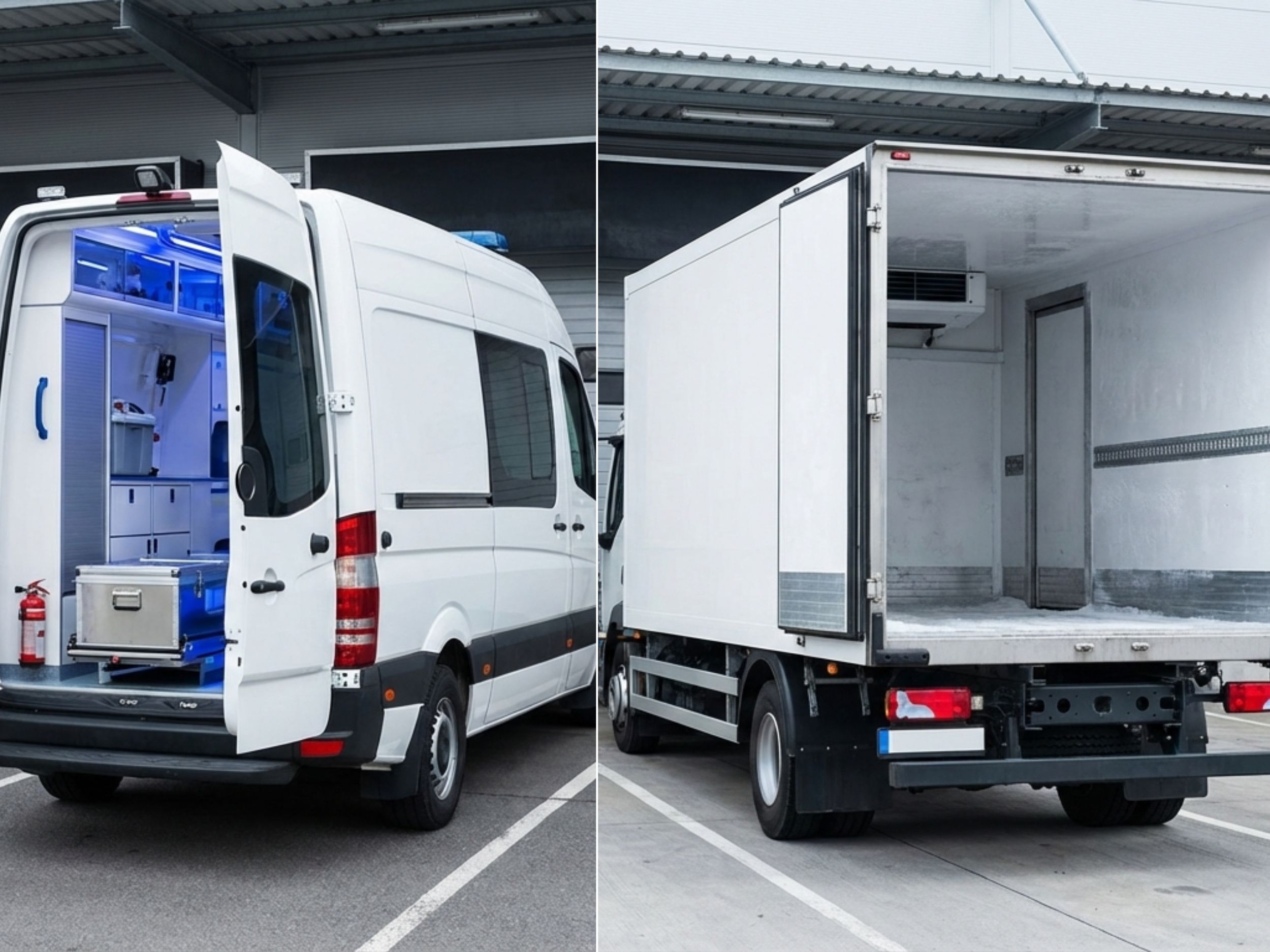
When an organ match is found, the race against time begins alongside challenges of temperature, distance, biology, and uncertainty. From recovery onward, organ survival depends on maintaining a stable cold chain. Rather than a direct path, organ transport involves multiple handovers, vehicles, checkpoints, traffic delays, weather changes, and airport procedures. At each stage, the organ faces risk. Refrigerated trucks create a protective environment maintaining precise temperatures, with continuous sensor monitoring and backup power systems ensuring the cold chain never fails.
Organ Transport via Refrigerated Trucks as a Risk-Managed System
Organ transport functions as a continuously monitored risk management system operating under severe biological time constraints. When an organ departs a donor facility, the objective extends beyond timely delivery to preserving clinical usability through a fragile chain of events where multiple failure modes remain possible. Medical organ transport operates more like critical infrastructure than conventional logistics, with every decision representing a fundamental risk assessment.
Thermal Risk in Organ Transport via Refrigerated Trucks
Each organ has narrow temperature tolerance limits. Brief temperature deviations outside acceptable ranges accelerate cellular damage and increase transplant rejection probability. Refrigeration systems function as the primary clinical safeguard protecting the organ's biological integrity throughout transport.
Time Risk
Time operates as a series of shrinking buffers rather than a single countdown. Delays at handover points, traffic congestion, weather disruptions, aircraft scheduling conflicts, or facility readiness issues erode these buffers. In emergency transport, time margins often collapse completely, forcing logistics teams into continuous crisis management while preserving temperature stability.
Mechanical and Power Risk
Every refrigeration system introduces mechanical exposure through compressor failures, power supply fluctuations, door cycling, and vibration stressing components across long distances. Advanced medical-use refrigerated trucks must anticipate these realities through redundant cooling circuits, backup power, rapid temperature recovery, and fault tolerance as baseline survival requirements rather than premium features.
Operational and Handoff Risk
Risk intensifies at transition points including operating theatre to transport vehicle, road to air, and airport to transplant center movements. Each handoff introduces potential for temperature drift, documentation errors, or data loss. The cold chain must function across imperfect, high-pressure transitions defining real-world organ recovery transport.
Failure Mode Management
In organ transport, not all failures carry equal consequences. Some failure modes remain recoverable while others prove terminal. A brief routing delay may survive intact thermal stability, though temperature excursions may permanently compromise the organ regardless of arrival speed. Mature transport systems identify which failures can be absorbed versus which must never occur.
Why Temperature Control in Organ Transport via Refrigerated Trucks Is Critical
The first lifesaving intervention in transplant medicine occurs when the organ enters a temperature-controlled environment, not in the operating room. Every clinical outcome thereafter reflects cold chain performance. During transport, no surgeon, medication, or medical device actively protects the organ. Only temperature control preserves tissue viability, slows cellular decay, and maintains transplant suitability across travel distance.
The refrigeration system functions as the single continuous clinical safeguard throughout the organ's entire pre-surgical lifecycle. While surgeons prepare and patients await, refrigeration preserves tissue integrity and transplant suitability across every kilometer. Consequently, refrigerated trucks serve as mobile clinical environments, with refrigeration system precision, resilience, and fault tolerance directly influencing transplant success rates. Manufacturers designing medical-transport reefers are effectively building medical equipment whose engineering decisions determine whether organs arrive in transplant-viable condition.
Design Philosophy: From Cooling Units to Life-Critical Infrastructure
In organ transport, refrigerated trucks function as mobile medical environments where refrigeration system performance directly determines organ transplant viability. This perspective reframes cold chain design from "maintaining coldness" to "safeguarding life amid uncertainty." Manufacturers build critical medical subsystems rather than passive vehicles.
Every organ transport mission involves multiple risk layers: temperature variation, mechanical stress, transit delays, and handoff vulnerabilities. The reefer represents the only constant throughout this chain. Unlike conventional cargo, failure proves irrecoverable, fundamentally changing design priorities. Medical transport systems must anticipate stress, recover from disruptions, and maintain absolute reliability.
Core Design Principles for Life-Critical Reefers
1. Absolute Temperature Integrity
Organs tolerate narrow temperature ranges, typically 2 degrees C to 8 degrees C. Any deviation risks cellular damage. Advanced emergency transport reefers must maintain consistent thermal conditions despite door openings, traffic delays, or extreme weather.
2. Redundancy and Fail-Safe Mechanisms
Backup compressors, dual power sources, and fail-safe circuits prove essential. In high-stakes organ operations, redundancy transforms potential catastrophic failure into a controlled incident.
3. Rapid Recovery Capabilities
Every transition introduces potential exposure. Sensitive organ transfers demand systems restoring optimal temperature within minutes, not hours.
4. Integrated Monitoring and Data Transparency
Continuous real-time monitoring enables organ transport teams to respond proactively. Telemetry tracking temperature, vehicle status, and environmental conditions allows intervention before minor deviations become critical failures.
5. Mechanical and Operational Resilience
Medical-use refrigerated trucks must withstand vibration, extended transit durations, and variable infrastructure quality. Life-critical design assumes these stressors as the baseline expectation.
When refrigerated trucks are engineered as life-critical infrastructure rather than standard cargo equipment, every element directly contributes to transplant success. This perspective shift elevates cold chain manufacturing from logistics support to a core healthcare enabler.
Conclusion
Organ transport represents a carefully orchestrated risk system where every decision, handoff, and temperature degree matters. Transplant success depends equally on engineering precision and surgical skill. The cold chain serves as the first and most critical defense protecting organ viability throughout emergency and routine human organ transport.
Refrigerated truck manufacturers play a pivotal role in this ecosystem. Life-critical design, redundancy, real-time monitoring, and operational resilience under stress prove essential rather than optional, directly influencing patient outcomes, operational reliability, and hospital trust in logistics partners.
Sub Zero Reefers leads the industry in purpose-built, high-performance refrigerated systems meeting these demanding requirements. By engineering reefers as mobile medical environments, every organ from liver transport through broader blood and organ transport arrives safely, reliably, and within precise temperature windows required for successful transplantation.