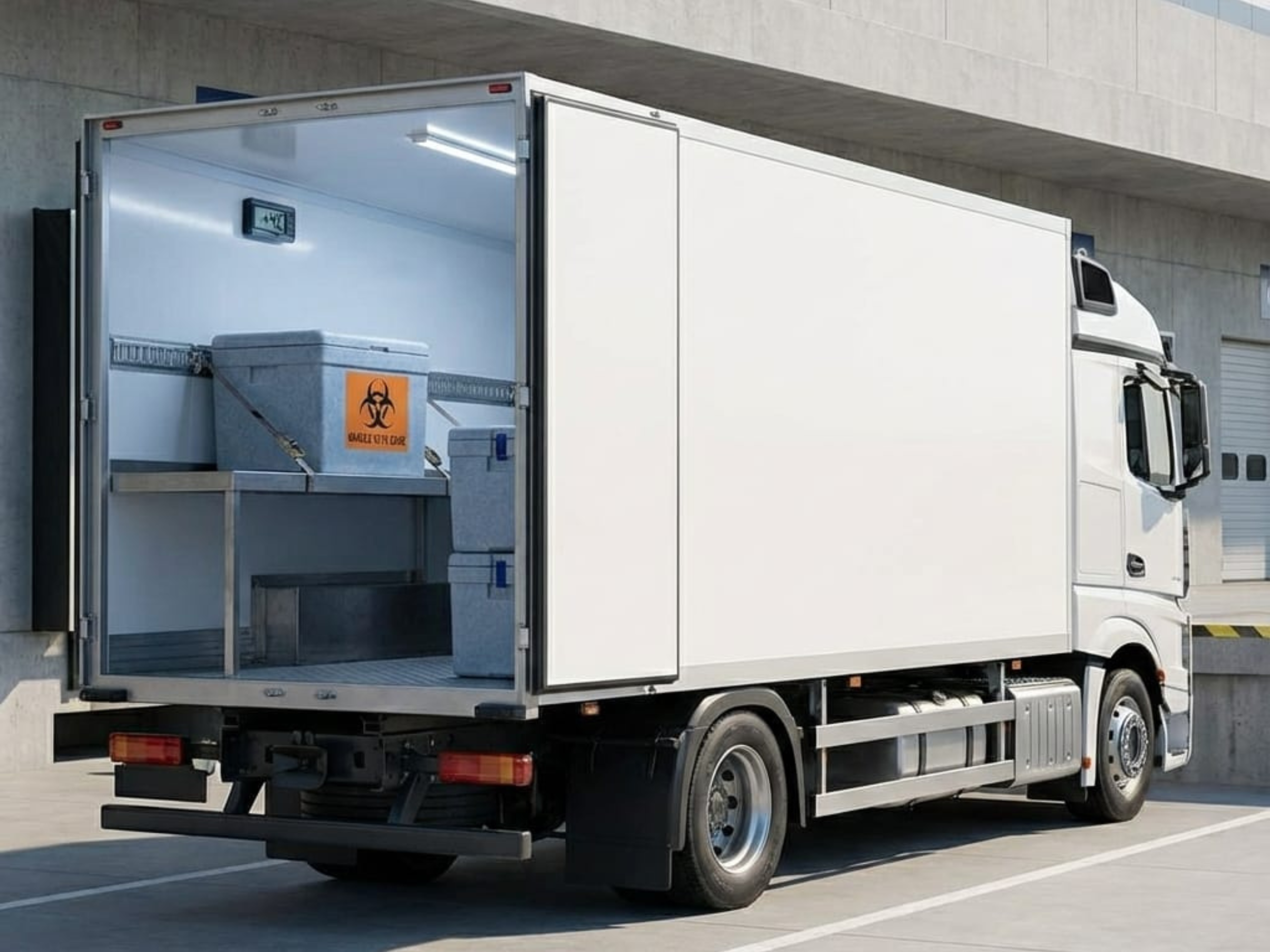
Transporting laboratory samples is more than moving containers. Blood, urine, tissue, and microbiological specimens are highly sensitive. Even small changes in temperature or handling can compromise results, delay diagnoses, or require recollection. This makes refrigerated trucks for laboratory sample transport essential for maintaining sample integrity.
Laboratory specimen transport ensures that conditions during transit closely match those at collection. Microbiological specimens, for example, are vulnerable to heat, which can accelerate bacterial growth, or freezing, which may damage cells. Transporting urine samples improperly can alter chemical balances or bacterial content, rendering tests unreliable. Timely delivery is also critical, delays can spoil samples despite careful packaging.
Security and traceability are equally important. Sensitive biological samples must be handled to prevent contamination or loss. Specialized lab sample transport trucks offer compartmentalized storage, secure packaging, and real-time monitoring, giving laboratories confidence that specimens remain intact.
Hospitals, diagnostic centers, research institutions, and pharmaceutical companies depend on safe lab specimen transport for accurate results and efficient operations. Sub Zero Reefers’ vehicles combine advanced insulation, precise temperature control, and flexible storage to keep every sample viable from pickup to delivery. Their high-performance lab sample transport trucks minimize risk, maintain operational efficiency, and uphold trust across the healthcare and research sectors.
The Critical Role of Temperature Control in Refrigerated Trucks for Laboratory Sample Transport
Maintaining the right conditions for laboratory samples isn’t a single problem with a single solution. What works for one specimen may not work for another, and what looks manageable in a controlled environment can quickly become complex once samples are on the road.
Temperature requirements vary, compliance standards are strict, transit routes are unpredictable, and security cannot be assumed. These overlapping factors define the real challenge of laboratory specimen transport and explain why effective lab specimen transport depends on purpose-built refrigerated trucks designed specifically for this level of precision.
- Temperature Sensitivity:Different samples have different refrigeration needs. Microbiological specimen transport often requires strict control between 2°C and 8°C, while blood products or certain enzymes may need even tighter ranges. Maintaining these temperatures consistently over long distances or through fluctuating environmental conditions can be difficult.
High-quality refrigerated trucks for laboratory sample transport from manufacturers like Sub Zero Reefers use advanced insulation and temperature management systems to keep samples within the required range, minimizing the risk of spoilage.
- Regulatory Compliance:Lab sample transport is governed by strict rules for packaging, labeling, and documentation. Non-compliance can result in fines or shipment rejection, which can delay research timelines or patient diagnostics.
Trucks built specifically for lab specimen transport are designed to support these regulatory standards, including compartmentalization for different sample types and secure handling features.
- Sample Integrity Over Distance:Moving samples through urban areas may seem straightforward, but cross-state or international shipments introduce additional challenges. Traffic delays, customs inspections, and storage constraints can all threaten sample quality.
By designing lab sample transport trucks with uniform cooling systems and compartmentalized storage, manufacturers ensure that each specimen maintains its integrity regardless of transit complexity.
- Security and Traceability:Biological samples are often sensitive, confidential, and high-stakes. Secure handling and monitoring are essential to prevent contamination or loss. Many modern refrigerated trucks include integrated sensors and real-time tracking technology, allowing for continuous oversight during transport. This feature is particularly important for microbiological specimen transport, where maintaining the right environment is critical for test accuracy.
By addressing these challenges at the design and manufacturing level, companies like Sub Zero Reefers provide trucks that are purpose-built for lab sample transport, combining precision, reliability, and compliance in every vehicle.
This ensures that healthcare providers, research institutions, and laboratories can rely on high-performance equipment to safely move sensitive specimens without compromise.
Also read: Temperature Controlled Logistics for Temperature Sensitive Drugs
Raising the Standard for Refrigerated Trucks for Laboratory Sample Transport
Meeting the demands of modern laboratory specimen transport requires more than careful handling and good intent. It requires vehicles that are engineered from the ground up for biological cargo. As testing volumes grow and turnaround times shrink, manufacturers of refrigerated trucks have had to rethink how temperature, airflow, monitoring, and storage work together inside a single vehicle. These innovations address the real-world challenges laboratories face every day.
Precision Temperature Control
Laboratory samples often need to stay within narrow temperature bands throughout transit. For microbiological specimen transport, even a short deviation can affect cell viability or test accuracy. Modern refrigeration systems are designed to maintain stable internal conditions regardless of outside weather, traffic delays, or door openings. Temperature recovery is faster, more controlled, and far more reliable than in conventional cold vehicles.
Uniform Cooling Across the Cargo Space
Temperature variation within the cargo area is a common but often overlooked risk in lab sample transport. Newer truck designs focus on balanced airflow and high-performance insulation to eliminate hot or cold spots. This ensures that samples placed anywhere inside the vehicle experience the same conditions, which is especially important when transporting urine samples alongside other biological materials.
Integrated Monitoring and Data Visibility
Refrigerated trucks built for lab specimen transport increasingly include embedded sensors that track temperature and system performance in real time. Instead of discovering issues at delivery, laboratories and logistics teams can monitor conditions throughout the journey. This level of visibility supports accountability, documentation, and faster decision-making when deviations occur.
Modular and Segregated Storage Design
Unlike food cargo, lab samples vary widely in handling and compliance requirements. Purpose-built lab sample transport trucks now feature modular interiors with compartmentalized storage. This allows different specimen types to be transported together safely while reducing the risk of cross-contamination and simplifying regulatory compliance.
Reliability in Real-World Conditions
Lab sample transport does not happen in ideal conditions. Trucks must perform through traffic congestion, long routes, and varying climates. Manufacturers like Sub Zero Reefers design refrigerated trucks to deliver consistent performance under stress, ensuring that sample integrity is maintained even when transit conditions are unpredictable.
Together, these innovations reflect a shift in how refrigerated trucks are designed for laboratory use. The focus is no longer just on cooling, but on precision, consistency, and confidence. By engineering vehicles specifically for lab sample transport, manufacturers help laboratories, hospitals, and research institutions safeguard the accuracy of their work and the outcomes that depend on it.
What Safe Lab Sample Transport Requires in Practice
Safe lab sample transport depends on how well the system performs under real-world conditions. Below are the core elements that determine whether laboratory specimens arrive usable, compliant, and unchanged.
- Stable transport conditions from the start: Samples should never be loaded into a vehicle that is still cooling down. Blood, urine, tissue, and microbiological specimens are sensitive to even brief temperature exposure. Refrigerated trucks built for laboratory specimen transport are designed to reach and hold target temperatures before loading begins, reducing early-stage risk.
- Consistent temperature control throughout transit: Different samples respond differently to temperature variation. Transporting urine samples requires protection against chemical shifts, while microbiological specimen transport demands steady cooling to preserve organism viability. Purpose-built trucks focus on maintaining uniform internal temperatures rather than relying on intermittent cooling.
- Uniform airflow across the cargo area: Uneven cooling inside the vehicle can compromise samples placed away from the refrigeration unit. Lab sample transport trucks are designed with optimized airflow and high-grade insulation so that temperature remains consistent across all storage zones.
- Structured loading and storage design: Overcrowding or poor stacking can block airflow and create warm pockets. Trucks engineered for lab specimen transport use modular interiors and defined storage zones that guide correct loading and help prevent accidental temperature variation.
- Continuous monitoring and traceability: Discovering a temperature breach at delivery is often too late. Modern refrigerated trucks support real-time temperature tracking, allowing deviations to be detected during transit. This visibility supports compliance, audit readiness, and confidence in sample quality.
- Reduced reliance on manual intervention: Human handling will always play a role, but design should minimise the risk of error. Intuitive controls, clear layouts, and stable refrigeration systems help drivers and handlers maintain conditions consistently, even during long routes or frequent stops.
- Reliability under unpredictable conditions: Traffic delays, route changes, and weather variations are unavoidable. Refrigerated trucks built for laboratory specimen transport are designed to perform reliably under stress, ensuring sample integrity even when transit does not go as planned.
How Sub Zero Reefers Differentiates in Refrigerated Trucks for Laboratory Sample Transport
Sub Zero Reefers does not approach laboratory applications as an extension of food or general cold chain transport. Its refrigerated trucks are designed and manufactured with temperature-critical use cases in mind, where consistency, control, and reliability matter more than volume or speed alone.
The differentiation begins at the manufacturing level. Sub Zero Reefers focuses on robust body construction, high-grade insulation, and refrigeration systems engineered for stable performance across long operating hours. This approach supports lab sample transport where temperature deviation, even for short periods, can compromise sample integrity.
Unlike adapted cold vehicles, Sub Zero Reefers designs refrigerated trucks to deliver uniform cooling across the cargo space. Airflow, insulation density, and structural layout are engineered to reduce internal temperature variation, which is essential for laboratory specimen transport and sensitive microbiological specimen transport.
Durability is another defining factor. Laboratory transport often involves frequent stops, variable routes, and unpredictable conditions. Sub Zero Reefers builds trucks to perform consistently under these realities, supporting reliable lab specimen transport without placing excessive dependence on manual intervention or corrective handling.
By manufacturing refrigerated trucks specifically for precision-driven applications, Sub Zero Reefers enables safer, more dependable lab sample transport. The result is equipment that supports accuracy, compliance, and confidence for laboratories and healthcare systems that cannot afford uncertainty in transit.
Conclusion
Safe transport of laboratory samples is not a supporting function. It is a critical link between accurate testing, reliable results, and real-world outcomes in healthcare and research. From temperature sensitivity and regulatory requirements to distance, security, and monitoring, laboratory specimen transport carries risks that can’t be managed through process alone.
What makes the difference is how the transport environment is built. Purpose-designed refrigerated trucks remove variability from the equation by delivering consistent temperature control, uniform airflow, and dependable performance under real-world conditions. For sensitive applications such as microbiological specimen transport, transporting urine samples, and other forms of lab sample transport, this level of precision is not optional. It is essential.
Sub Zero Reefers brings this precision to life through manufacturing that is focused on application, not just adaptation. By engineering refrigerated trucks specifically for lab specimen transport, Sub Zero Reefers enables laboratories, research institutions, and healthcare providers to protect sample integrity, support compliance, and operate with confidence at every stage of transit.
As diagnostic volumes grow and testing timelines become more demanding, the reliability of the cold chain matters more than ever. Investing in the right lab sample transport truck is ultimately an investment in accuracy, trust, and outcomes that stand up to scrutiny.
