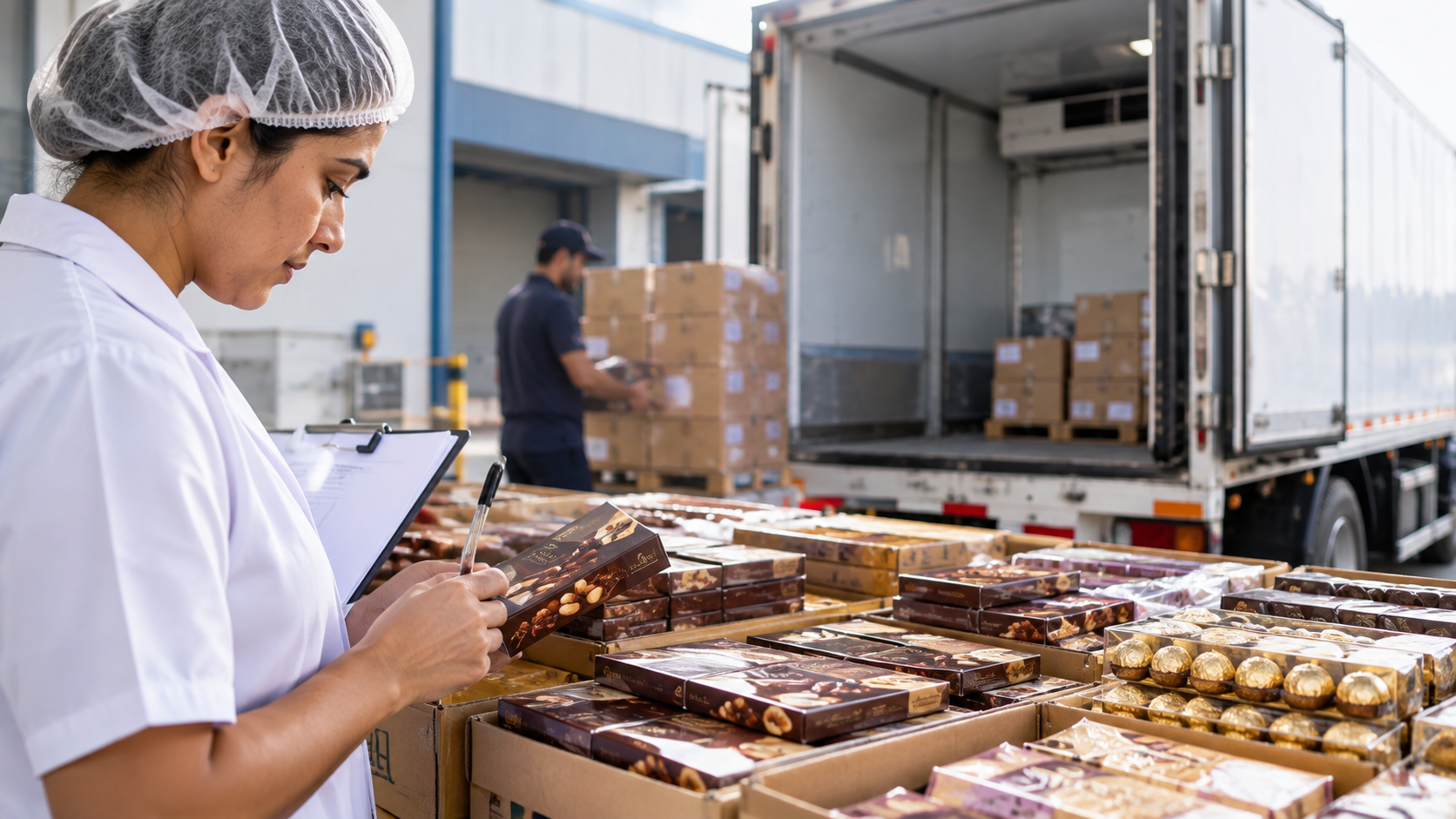
Chocolate may be one of the most popular confectionery products, but it is also one of the more sensitive products to transport. Leave a chocolate bar, praline or coated confectionery item in a hot vehicle for too long and it can soften, lose its shape or begin to melt. Even when it does not visibly melt, exposure to fluctuating temperatures and moisture can cause fat bloom or sugar bloom, leaving a whitish or dull surface that affects its appearance and texture.
This becomes a bigger challenge as chocolate moves through the supply chain. A product may leave a temperature-controlled production facility, spend time at a loading dock, travel through high ambient temperatures in a delivery vehicle, and then move into another warehouse or retail outlet. Every one of these transitions creates an opportunity for temperature to drift outside the product's preferred range.
For manufacturers, distributors and retailers, the consequences go beyond a chocolate bar looking less appealing. Melted or bloomed products can lead to damaged packaging, rejected consignments, returns, product wastage and dissatisfied customers. During India's hotter months, these risks become even more significant as ambient temperatures can rise well above the conditions chocolate needs for maintaining its quality.
This is why cold chain management plays an important role in confectionery distribution. The objective is not simply to keep chocolate cold. It is to maintain a stable and suitable environment from production and storage through loading, transportation and final delivery. A properly planned cold chain system brings together temperature-controlled storage, suitable cold chain equipment, insulated transportation and temperature monitoring to protect product quality throughout the journey.
For businesses, the challenge is finding the right balance between protecting a temperature-sensitive product and keeping the cost of storage and transportation under control.
Why Chocolate Needs a Careful Cold Chain Management and Cold Storage Business
Chocolate may seem easier to transport than frozen food because it does not need to be kept at sub-zero temperatures. However, that does not mean it can simply be moved in a regular vehicle and exposed to changing weather conditions. Chocolate is sensitive to heat, moisture and temperature fluctuations, and even a short period of poor temperature control can affect how the product looks, feels and performs when it reaches the customer.
This becomes particularly important as chocolate moves through multiple stages of the supply chain. A product may leave a controlled production environment, spend time at a loading dock, travel through high ambient temperatures, and then be unloaded at another warehouse or retail outlet. Each transition creates a potential temperature risk. Understanding what happens to chocolate under these conditions helps explain why a well-managed cold chain is essential.
What Happens to Chocolate Quality When Cold Chain Management Fails
When chocolate is exposed to excessive heat, it can soften, lose its shape or melt. This is particularly problematic for products such as pralines, truffles, coated confectionery and moulded chocolates, where the product's shape and finish are an important part of its appeal. Once melted chocolate cools and solidifies again, it may not return to its original appearance or texture.
Heat exposure can also affect packaging. Melted or softened chocolate may stick to wrappers, deform boxes or leave visible marks on packaging. For manufacturers and distributors, this can turn a temperature excursion into a product-quality and presentation issue.
How Temperature Fluctuations in Cold Chain Logistics Affect Chocolate Quality
The risk is not limited to chocolate being exposed to very high temperatures. Repeated cycles of warming and cooling can also affect its physical properties. Changes in temperature can contribute to fat bloom, where cocoa butter migrates to the surface and creates a pale or whitish appearance. Moisture and condensation can contribute to sugar bloom, which can leave the surface rough or grainy.
While these changes do not necessarily mean that the chocolate is unsafe to eat, they can significantly affect its appearance, texture and overall quality. For premium confectionery, where presentation is closely tied to perceived value, this distinction matters.
When Cold Chain Failure Makes Chocolate Commercially Unacceptable
A chocolate product does not have to be spoiled to become a commercial loss. A bar with a dull, bloomed surface, a misshapen praline or packaging damaged by melting may still be edible, but it may no longer meet the quality expectations of a retailer or customer.
This is why temperature control in confectionery logistics should be viewed as a quality and cost-management measure, not simply a food-safety requirement. Preventing heat exposure and temperature fluctuations can help businesses reduce wastage, rejected consignments, returns and customer complaints while protecting the consistency of the product throughout its journey.
Also Read: Benefits of Working with Reliable Cold Storage Manufacturers
Cold Storage Business for Chocolate: Infrastructure, Capacity and Construction Cost
Once the sensitivity of chocolate is understood, the next question is where temperature control needs to begin. Transportation is only one part of the equation. Chocolate may spend hours or even days in storage before it reaches a distributor, retailer or customer, which means the storage environment needs to be managed just as carefully as the vehicle carrying it.
For businesses handling significant volumes of confectionery, this makes cold storage an important operational investment. However, the right facility is not necessarily the biggest or most heavily refrigerated one. The objective is to create a stable environment that protects product quality while keeping construction, energy and operating costs proportionate to the business.
What Does a Cold Storage Business Need to Protect Chocolate Quality?
A cold storage facility for chocolate needs to maintain consistent conditions rather than simply achieve a low temperature. The appropriate range will depend on the type of chocolate, formulation, packaging and manufacturer's specifications, but stability is generally critical to preventing melting, bloom and other quality issues.
The facility should therefore be designed around effective insulation, reliable refrigeration, controlled airflow and appropriate humidity management. Well-sealed doors, sufficient product spacing and regular temperature monitoring also help minimise fluctuations within the storage area. These considerations become particularly important in warmer climates, where heat entering the facility can increase the refrigeration load.
What Determines Cold Storage Business Cost for Confectionery Facilities?
The cold storage business cost depends on much more than the refrigeration system itself. Businesses need to account for the size and location of the facility, storage capacity, insulation, refrigeration equipment, electrical infrastructure, temperature monitoring, material-handling systems, labour and ongoing maintenance.
Energy consumption is another major consideration. A facility that is inexpensive to construct but poorly insulated may require more energy to maintain its operating conditions over time. For this reason, businesses should evaluate cold storage costs across the facility's lifecycle rather than focusing only on the initial investment.
How Cold Storage Construction Cost Is Calculated for Chocolate Facilities
The cold storage construction cost is influenced by the physical design and technical requirements of the facility. Building structure, insulated panels, flooring, doors, refrigeration capacity, electrical systems and temperature-control requirements can all affect the initial investment.
Capacity also matters. A facility designed for a large volume will naturally require more infrastructure, but building significantly more capacity than the business can utilise can tie up capital and increase ongoing energy costs. The right approach is to assess current inventory volumes, seasonal demand, expected growth and distribution requirements before finalising the facility size.
Build, Rent or Outsource: Evaluating Your Cold Storage Business Options
Not every confectionery business needs to invest in its own cold storage facility. A manufacturer with high and predictable volumes may benefit from owning infrastructure, particularly when consistent utilisation can justify the capital investment. Smaller or seasonal businesses may find third-party cold storage more practical, as it allows them to access temperature-controlled facilities without taking on the full construction and maintenance burden.
A shared or outsourced model can also make sense when a business is expanding into new markets and wants to test demand before investing in regional infrastructure. The decision ultimately comes down to volume, utilisation, seasonality, geographic reach and available capital.
The key is to treat cold storage as part of the wider cold chain management strategy. A well-designed facility protects the product while it is stationary, but that protection needs to continue once the chocolate leaves the warehouse and enters transportation.
Also Read: Cold Storage Manufacturers: Backbone of India's Cold Chain
What Does Chocolate Cold Chain Logistics Really Cost? A Cold Storage Business Perspective
The cost of cold chain logistics for chocolate goes beyond simply paying for a refrigerated vehicle or cold storage facility. Businesses need to account for transportation, storage, energy, maintenance, labour and temperature monitoring, while also considering whether it makes more sense to own, rent or outsource these assets. The right approach depends largely on shipment volumes, delivery distances, seasonality and how consistently the infrastructure will be used. For example, owning a refrigerated truck may be practical for a manufacturer with regular distribution requirements, while renting or outsourcing may be more cost-effective for a smaller or seasonal business.
The overall cost can include:
- Purchase or lease cost of a refrigerated truck or reefer van
- Insulated body and refrigeration equipment
- Fuel or energy consumption
- Driver and operational costs
- Temperature monitoring and data logging
- Vehicle insurance, registration and taxes
- Preventive maintenance and refrigeration servicing
- Cold storage and warehouse charges
- Loading, unloading and handling costs
- Third-party logistics and distribution charges
Outsourcing transportation and storage can reduce the need for major upfront investment, particularly when volumes are unpredictable or distribution covers multiple regions. However, businesses should also consider service reliability, vehicle availability, temperature visibility and peak-season capacity before choosing a logistics partner. Similarly, investing in owned infrastructure can offer greater control but may become expensive if vehicles or storage facilities remain underutilised for long periods.
The cost of a cold chain system also needs to be viewed against the potential cost of failure. Chocolate that melts, develops bloom or suffers packaging damage can result in rejected consignments, product wastage, returns, emergency redistribution and customer complaints. In this context, choosing the cheapest transportation or storage option may not necessarily reduce the overall cost.
A more practical approach is to evaluate the total lifecycle cost of the cold chain and match the investment to actual business requirements. The objective is not to build the most expensive system, but to create a reliable chain of storage, handling, transportation and monitoring that protects chocolate quality without adding unnecessary operating costs.
How to Build a Cold Storage Business and Cold Chain for Chocolate in India
Bringing together everything above, here is a practical, step-by-step way to plan cold storage business infrastructure and cold chain logistics for chocolate transport.
-
Understand Chocolate's Temperature Sensitivity
Chocolate requires stable conditions around 15°C to 18°C. It is vulnerable to fat bloom from temperature cycling and sugar bloom from humidity exposure. Neither makes the product unsafe — but both make it commercially unacceptable. Cold chain management must prioritise stability over simply achieving a low temperature.
-
Plan Your Cold Storage Business Infrastructure
Design the cold storage facility around effective insulation, reliable refrigeration, controlled airflow and humidity management. Cold storage construction cost depends on capacity, insulation quality, refrigeration equipment, electrical infrastructure and automation. Evaluate lifecycle cost — not just the upfront cold storage business cost.
-
Decide: Build, Rent or Outsource Cold Storage
High-volume manufacturers with consistent utilisation benefit most from owned cold storage business infrastructure. Smaller or seasonal operations may find third-party cold storage more cost-effective. Evaluate volume, seasonality, geographic reach and available capital before committing to a cold storage construction cost.
-
Select the Right Refrigerated Transport Vehicle
Choose between a reefer van for urban last-mile confectionery distribution and a refrigerated truck for longer routes and larger volumes. For mixed confectionery loads requiring different temperature zones, evaluate a multi-temperature reefer truck that maintains stable cold chain logistics conditions across all compartments.
-
Implement Temperature Monitoring Across the Chain
Temperature monitoring should cover both cold storage and transportation. Data loggers in the reefer van or refrigerated truck, combined with facility monitoring systems, create a continuous record of cold chain management conditions — helping identify excursions before they cause product loss.
-
Calculate Total Cold Chain Cost vs Product Loss Risk
Evaluate the full cost of cold chain logistics — including cold storage business cost, vehicle ownership, fuel, maintenance, monitoring and labour — against the potential cost of rejected consignments, returns and product wastage. The most cost-effective cold chain is not the cheapest one; it is the one that protects product quality consistently.
Conclusion
Chocolate may not require frozen temperatures, but it does require a carefully controlled journey from production to the final point of sale. From storage conditions and loading practices to transportation, monitoring and last-mile delivery, every stage can influence the product's quality, appearance and shelf value. A reliable cold chain management strategy therefore needs to balance product requirements with practical considerations such as operating costs, utilisation, seasonal demand and distribution distances.
For confectionery businesses, the goal is not simply to invest in more refrigeration. It is to build a cold chain system where each component works together to minimise temperature fluctuations and protect the product throughout its journey. The right combination of cold storage, cold chain equipment, monitoring and temperature controlled vehicles can help businesses reduce avoidable losses while maintaining consistency as they scale.
SubZero Reefers approaches refrigerated transportation with this balance in mind, focusing on insulated vehicle bodies and temperature-controlled solutions designed for the demands of modern cold chain operations. For businesses evaluating their next step in confectionery logistics, understanding the product, route and operating conditions first can help determine what kind of refrigerated transport solution makes sense for the journey ahead.
Frequently Asked Questions
1. What temperature is required to transport chocolate?
Chocolate is generally transported in a controlled environment around 15°C to 18°C, depending on the product and manufacturer's specifications. Stable temperatures are more important than simply keeping the product cold — temperature fluctuations in cold chain logistics are the primary cause of fat bloom and sugar bloom.
2. Does Indian mithai need refrigerated transport?
Not always. It depends on the type of mithai, ingredients and travel duration. Perishable varieties containing dairy, khoya or fresh cream may require cold chain logistics and a temperature-controlled vehicle to maintain quality throughout the cold storage business and distribution process.
3. What is the cost of a temperature-controlled van for confectionery?
The cost varies based on vehicle size, insulation, refrigeration capacity, temperature range and monitoring systems. Businesses should also factor in maintenance, energy, insurance and operating costs when evaluating a reefer van for cold chain management of confectionery.
4. How does humidity affect chocolate during transport?
High humidity can cause condensation and contribute to sugar bloom, leaving chocolate with a rough or whitish surface. Proper humidity control, packaging and a stable cold chain system can help minimise these quality issues during cold storage and transportation.
5. Can chocolate and chilled products be transported in the same multi-temp reefer?
Yes, a multi-temp reefer can transport products requiring different temperature zones, provided the vehicle is properly configured. Products should be segregated according to their required conditions to avoid compromising chocolate quality during cold chain logistics operations.
6. What cold storage temperature is required for chocolate?
Chocolate is generally stored in a cool, stable environment around 15°C to 18°C, depending on formulation and manufacturer requirements. A well-designed cold storage business with proper insulation, cold chain equipment and humidity management is essential for maintaining consistent conditions.