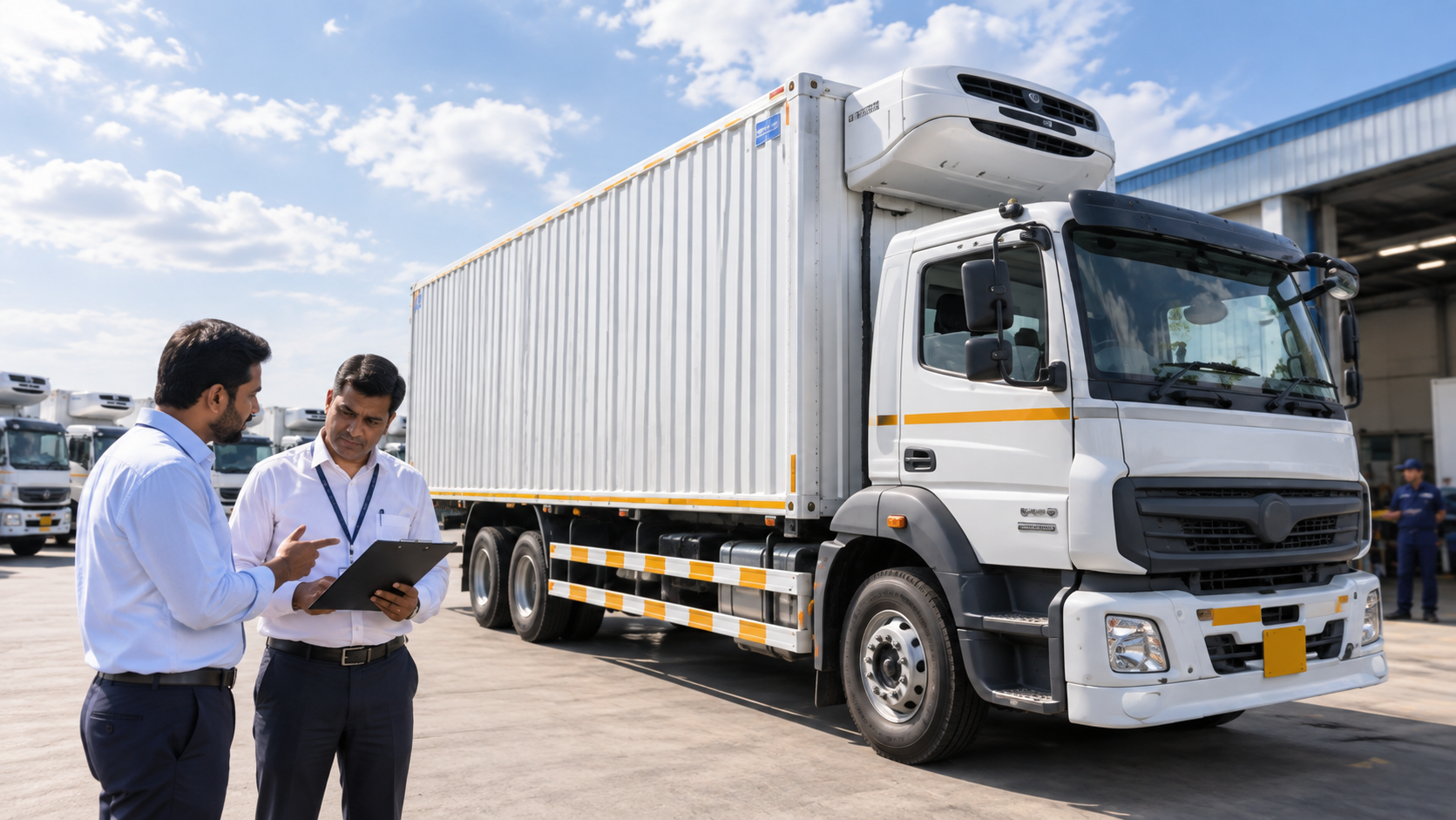
For a manufacturing business dealing with products that are sensitive to temperature, the production line is only one part of the quality equation. What happens after the product leaves the factory can be just as critical.
Dairy products, frozen foods, processed meat, seafood, pharmaceuticals, certain chemicals and other temperature-sensitive products can be affected by exposure to unsuitable temperatures during transportation. A product can leave a highly controlled manufacturing environment in perfect condition, yet lose its quality or shelf life somewhere between the plant, warehouse, distributor and customer.
This is where a reefer truck becomes more than a mode of transportation. It becomes an extension of the manufacturing environment.
A well-designed refrigerated truck helps maintain the temperature conditions established during production, storage and processing while the product is in transit. For manufacturers, this can directly influence product quality, shelf life, wastage, regulatory compliance and ultimately the reliability of the supply chain.
The challenge, however, is that refrigerated transportation is not simply about installing a refrigeration unit on a commercial vehicle. The performance of a reefer vehicle depends on how effectively its refrigeration system, insulated body, doors, flooring, airflow and overall construction work together. The vehicle also has to perform reliably through India’s varied climatic and road conditions, while carrying the required payload and operating within the economics of the business.
This makes the choice of a refrigerated truck manufacturer an important operational decision.
The right manufacturer needs to understand what happens inside the cargo body as well as what happens on the road. It needs to account for the product being transported, required temperature range, journey duration, loading frequency, ambient conditions, payload requirements and maintenance realities. For a manufacturing business, these considerations can ultimately determine whether its cold chain is merely functional or genuinely dependable.
So, before investing in a reefer truck, what should manufacturers and fleet operators actually evaluate?
10 Checks For Choosing a Reefer Truck Manufacturer in India
Here are 10 checks that can help make that decision more informed.
-
Start With the Product, Not the Vehicle
The first mistake in selecting a reefer vehicle is to start with the vehicle itself. The right starting point is the product.
Different products have different temperature requirements, and those requirements determine how the vehicle should be designed. A pharmaceutical shipment requiring a tightly controlled temperature range presents a very different challenge from frozen food travelling over a long-haul route. Similarly, a dairy distributor making multiple urban deliveries will have a very different operating cycle from a manufacturer moving pre-cooled cargo from one facility to another.
A competent refrigerated truck manufacturer should therefore spend time understanding the application before recommending a specification. The conversation should cover the nature of the cargo, required temperature range, journey duration, loading conditions, number of stops, frequency of door openings and whether the product is pre-cooled before it enters the vehicle.
This matters because refrigeration capacity, insulation requirements and body configuration are all influenced by these variables. In other words, there is no universally “right” reefer. There is only a reefer that is appropriately engineered for a particular application.
-
Look Beyond the Refrigeration Unit and Examine Insulation Quality
When businesses evaluate a refrigerated truck, the refrigeration unit often becomes the headline specification. But cooling capacity alone does not determine temperature performance. The vehicle’s insulated body plays an equally important role.
The refrigeration system generates and maintains the required temperature, while the insulated body limits the amount of heat entering the cargo compartment from the external environment. If the body allows excessive heat ingress, the refrigeration system has to work harder to maintain the target temperature.
This becomes particularly important in India’s operating environment, where vehicles can encounter high ambient temperatures, humidity, dust and long periods of road travel. The quality of an insulated vehicle therefore depends on much more than the material inside its panels. The construction of the panels, floor, roof, doors, joints and corners all contribute to the body’s thermal performance.
When evaluating a manufacturer, it is worth understanding:
- What insulation technology is being used?
- How are the panels constructed and joined?
- How is the floor insulated?
- How effectively do the doors seal?
- How are thermal bridges minimised?
- How is the body protected against moisture ingress?
A well-engineered refrigeration system paired with an inefficient body can undermine the performance of the entire vehicle.
-
Match the Refrigeration System to Your Reefer Truck’s Duty Cycle
The biggest refrigeration unit is not necessarily the right refrigeration unit. What matters is whether the system is appropriately sized for the vehicle’s actual duty cycle. Consider two vehicles operating in completely different environments. One may transport pre-cooled frozen products for several hours with minimal door openings. Another may be a reefer van making frequent deliveries across a city, with its doors opened repeatedly at different customer locations.
Although both require refrigeration, the thermal demands are very different. The manufacturer should consider the body volume, cargo characteristics, desired temperature, ambient conditions, route duration and frequency of door openings before specifying the refrigeration system.
There is another distinction that is often overlooked: temperature maintenance versus temperature pull-down. A reefer is primarily designed to maintain the temperature of cargo that has already been appropriately conditioned. If warm cargo is loaded into the vehicle and the refrigeration unit is expected to rapidly bring it down to the required temperature, the thermal load can be significantly higher.
Understanding this distinction helps prevent refrigeration systems from being either under-specified or unnecessarily oversized.
-
Consider Payload as Carefully as Temperature Performance
Temperature control is fundamental, but a refrigerated vehicle is also a commercial asset. It has to transport the required amount of cargo economically. The body, insulation, flooring and refrigeration equipment add weight to the base vehicle. This makes the relationship between body weight and payload particularly important for high-utilisation fleets.
However, lightweight construction should never be pursued at the expense of thermal performance or structural durability. The objective should be to find the right balance between: thermal efficiency, structural strength, body weight, payload and durability.
For a fleet completing hundreds or thousands of trips, even a relatively small difference in usable payload can have a significant effect on overall fleet economics. This is why manufacturers should be able to explain not only how their refrigerated body performs thermally, but also how its construction affects payload and vehicle efficiency. A reefer that protects the cargo but consistently carries less productive payload than the application demands may not deliver the operational efficiency the business needs.
-
Examine How the Reefer Body Is Built for Real-World Conditions
A refrigerated body may be engineered around temperature control, but it still has to survive the realities of commercial transportation. Indian logistics operations can involve rough roads, frequent loading and unloading, dock impacts, vibration, changing weather conditions and intensive daily utilisation. The body therefore needs to combine thermal performance with structural resilience.
This is particularly important around areas that experience repeated physical interaction, such as doors, floors, rear sections and loading zones. A manufacturer should be able to demonstrate how the body is designed to withstand these conditions and, equally importantly, how easily it can be repaired if damage does occur.
Repairability is often overlooked during procurement. Yet a vehicle that can be repaired quickly and efficiently can spend more time on the road and less time in a workshop. The focus should therefore be on the entire lifecycle of the body, not just how it performs when it is new.
Also Read: How Refrigerated Truck Manufacturers Ensure Compliance
-
Determine Whether a Multi-Temperature Reefer Truck Suits Your Operation
As cold chain networks become more sophisticated, businesses are increasingly moving different categories of temperature-sensitive products through the same distribution network. This is where multi-temperature refrigeration can become relevant.
A multi-temperature reefer vehicle can be divided into separate temperature-controlled compartments, allowing products with different temperature requirements to be transported within the same vehicle. For a distributor, this can potentially improve vehicle utilisation and reduce the need to operate separate vehicles for different product categories.
But multi-temperature capability should not be treated as an automatic upgrade. It needs to make sense operationally. Compartment sizes, cargo volumes, delivery sequences, temperature requirements and loading patterns all need to be considered. If the configuration does not match the actual distribution model, additional complexity can outweigh the intended benefit.
The manufacturer should therefore approach multi-temperature design as an application-engineering exercise rather than simply a product feature.
-
Investigate the Refrigerated Truck Manufacturer’s Quality and Manufacturing Capabilities
The finished vehicle is only as good as the manufacturing process behind it. This becomes especially important for businesses purchasing multiple vehicles. Fleet operators need consistency, not just a single well-built reefer truck. The body construction, insulation, component integration and finishing should remain consistent from one vehicle to the next. This helps simplify fleet maintenance, driver familiarisation and operational management.
Before selecting a refrigerated truck manufacturer, understand the organisation’s manufacturing capabilities, engineering expertise and quality-control processes.
Look for evidence of:
- Dedicated manufacturing infrastructure
- In-house engineering capabilities
- Controlled production processes
- Quality inspection and testing
- Experience with different chassis platforms
- Ability to deliver customised fleet requirements
- Scalable manufacturing capacity
Manufacturing capability is ultimately about repeatability. For a fleet operator, consistency across 10, 50 or 100 vehicles can matter just as much as the specification of the first vehicle delivered.
-
Treat After-Sales Support as Part of the Refrigerated Truck Investment
The purchase of a reefer does not end when the vehicle leaves the manufacturer’s facility. In fact, the manufacturer’s support becomes arguably more important once the vehicle enters commercial operation. A breakdown involving a conventional commercial vehicle can mean lost operating time. A breakdown involving a temperature-controlled vehicle can potentially create an additional concern: the cargo itself may be exposed to unsuitable conditions. This makes serviceability, spare parts and technical support critical considerations.
Before finalising a manufacturer, businesses should understand its service coverage, response mechanisms, spare-parts availability and capabilities for both refrigeration-system and body-related repairs. Warranty terms should also be examined carefully. It is important to understand what is covered, for how long and how claims are handled. For fleets operating across multiple regions, a strong service network can be a significant operational consideration. The real measure of a manufacturer is therefore not only how well it builds the vehicle, but how well it supports that vehicle throughout its working life.
-
Evaluate the Reefer Truck as Part of Your Wider Cold Chain Logistics System
No reefer vehicle operates in isolation. It is one component within a much larger system that may include manufacturing, pre-cooling, processing, cold storage, loading infrastructure, transportation, distribution centres and last-mile delivery.
Think of the cold chain as a continuous temperature-controlled journey: manufacturing → pre-cooling → cold storage → loading → refrigerated transport → distribution → delivery.
The reefer can maintain the required environment during transportation, but it cannot compensate for weaknesses elsewhere in the chain. For example, if products are not adequately pre-cooled before loading, the refrigeration system may have to deal with a much higher thermal load. Similarly, prolonged exposure during loading and unloading can introduce heat into the cargo compartment.
This is why cold chain logistics needs to be viewed holistically. It is also important to understand the role of different types of cold chain equipment. A cold storage facility, an insulated vehicle, a refrigerated truck and a reefer container may all contribute to temperature-controlled logistics, but they solve different problems within the supply chain. The best vehicle decision is therefore one that fits into the wider cold chain rather than one that is evaluated independently.
-
Think Beyond Today’s Requirement When Choosing a Refrigerated Truck Manufacturer
A refrigerated vehicle can remain an operational asset for years. During that time, the business may expand into new markets, add product categories, change distribution models or adopt new vehicle technologies.
That makes future-readiness an important consideration when selecting a manufacturer. A manufacturer with a broader portfolio and engineering capability may be able to support changing requirements across different stages of a business’s growth—from a smaller reefer van for urban distribution to larger refrigerated bodies, multi-temperature solutions, EV reefers or specialised applications.
This does not mean businesses should buy technology they do not currently need. Instead, they should understand whether the manufacturer has the capability to evolve alongside their requirements. The question is simple: Can the manufacturer support not only the vehicle you need today, but the cold chain you are likely to build tomorrow? That perspective can be particularly valuable for manufacturers looking at long-term fleet standardisation and expansion.
Conclusion
For manufacturers and businesses handling temperature-sensitive products, a reefer truck is much more than a transportation asset. It is a moving extension of the controlled environment in which the product is manufactured, processed and stored. Any weakness in its insulation, refrigeration system, body construction or serviceability can have a direct impact on the integrity of the cold chain.
That is why choosing a refrigerated truck manufacturer should go beyond comparing prices and specifications. The right decision requires looking at the complete picture—from the cargo and its temperature requirements to payload, route conditions, body design, refrigeration performance, maintenance and long-term operational support.
At Sub Zero Reefers, this understanding forms the foundation of how refrigerated transportation solutions are engineered. With expertise in refrigerated and insulated vehicle bodies, Sub Zero offers solutions across refrigerated trucks, multi-temperature reefers, EV reefers, specialised applications and refrigerated containers. The focus is on developing temperature-controlled transportation solutions that are built around the practical requirements of modern cold chain logistics.
Because when the product you’re transporting cannot afford a temperature compromise, the vehicle carrying it shouldn’t either.
Frequently Asked Questions
1. What should I check before buying a reefer truck body?
Check insulation, thermal performance, body strength, payload, door sealing, refrigeration compatibility, durability, repairability and after-sales support.
2. Which reefer truck body manufacturers are best in India?
Compare manufacturers based on engineering expertise, manufacturing quality, customisation, service network, experience and proven performance rather than price alone.
3. What warranty should a reefer body manufacturer offer?
Look for clear warranty coverage for workmanship, body structure and insulation, along with defined terms, exclusions and after-sales support.
4. How do I verify the quality of a reefer truck manufacturer?
Evaluate its manufacturing facilities, quality-control processes, engineering capabilities, industry experience, customer references and track record with similar applications.
5. What certifications should a reefer body manufacturer have?
Check for applicable quality-management certifications, vehicle homologation and testing requirements relevant to the vehicle, application and cargo being transported.
6. How do I compare reefer truck body manufacturers in India?
Compare them on insulation, body construction, payload, refrigeration integration, customisation, quality consistency, service support and total cost of ownership.