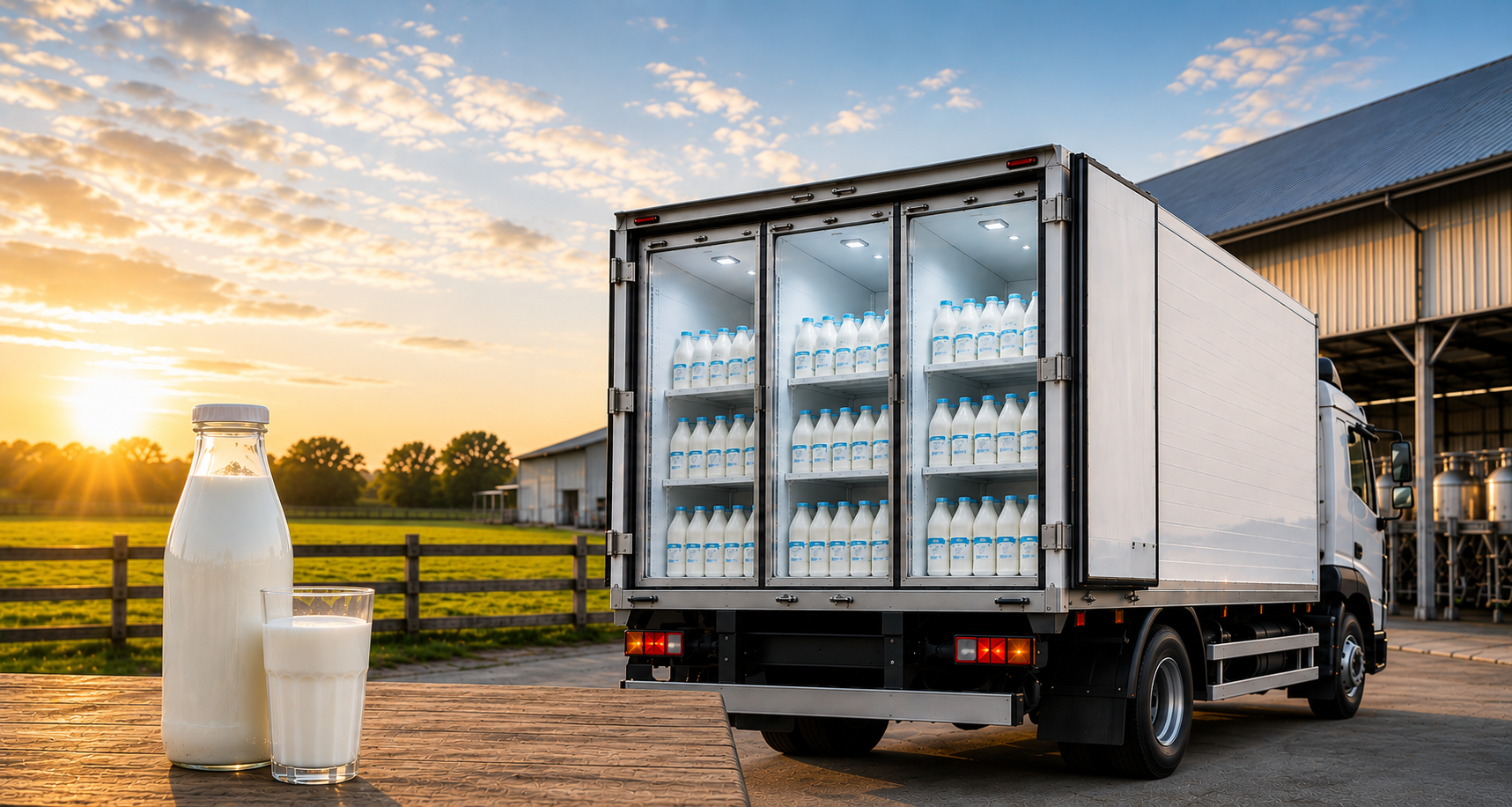
Every morning, millions of households begin their day with a glass of milk. It goes into tea, coffee, breakfast cereals, school tiffins, and countless recipes. It's one of the few essentials that people expect to find fresh on store shelves every single day, rarely stopping to think about the journey it has taken.
Behind every litre of milk is a carefully managed transportation network. Milk travels from farms to collection centres, then to processing plants, distribution hubs, and finally to retailers. Throughout this journey, there's very little room for error. Even a slight rise in temperature can affect quality, reduce shelf life, and lead to spoilage before the product ever reaches the consumer.
This makes milk transport one of the most critical links in the dairy supply chain. It's no longer just about moving products from one location to another. It's about preserving freshness, maintaining food safety standards, reducing wastage, and ensuring the integrity of the entire cold chain logistics ecosystem.
For dairy businesses, this is where the choice of a milk truck becomes a strategic investment rather than a simple vehicle purchase. While many buyers start by comparing milk truck price, the upfront cost tells only part of the story. Factors such as insulation quality, refrigeration efficiency, body construction, operating costs, and long-term reliability have a far greater impact on the overall value of the investment.
In this guide, we'll break down what influences milk truck price, the features that matter most, and how businesses can evaluate long-term value instead of focusing solely on the purchase price.
Also Read: Trusted Milk Truck Manufacturers in India for Dairy Industry
Why Dairy Transportation Demands a Purpose-Built Milk Truck
Transporting milk isn't simply about moving it from one location to another. It is about preserving a product that is highly sensitive to time, temperature, and handling conditions. Unlike packaged goods that can withstand variations during transit, milk requires a carefully controlled environment throughout its journey. Any disruption, whether caused by heat exposure, traffic delays, or inadequate insulation, can affect its freshness, shorten its shelf life, and increase the risk of spoilage. For dairy businesses, this translates into product losses, higher operating costs, and potential damage to customer trust.
This is where a purpose-built milk truck becomes an essential part of the cold chain rather than just another transport vehicle. Designed with insulated body construction and refrigeration systems, it helps maintain consistent temperatures regardless of external conditions, ensuring the quality achieved at the processing plant is preserved until delivery. Beyond protecting the product, these vehicles also support regulatory compliance, improve operational efficiency, and reduce wastage across the supply chain.
In an industry where freshness directly influences profitability, investing in the right transportation solution is not just about logistics. It is about safeguarding product quality, strengthening supply chain reliability, and creating long-term value for the business.
Milk Truck Price Explained: What Your Investment Actually Covers
The milk truck price is made up of several key components, each contributing to the vehicle's performance, durability, and long-term efficiency. While the total investment varies based on the application, understanding where the cost goes helps businesses evaluate value rather than simply comparing quotations. From the chassis and insulated body to the refrigeration unit, every element plays a role in ensuring reliable dairy transportation.
1. Milk Truck Chassis: The Foundation of Your Dairy Transport Investment
The chassis is the backbone of the vehicle and largely determines its payload capacity, route suitability, and overall performance. The right choice depends on how much milk needs to be transported and the distance it will travel.
For smaller urban distribution routes, vehicles like the Mahindra Bolero 2.0 (10 ft) are available with a chassis price of approximately ₹8.2 lakh, while the Eicher 2049 (10 ft) is priced around ₹9.7 lakh. Businesses handling larger volumes can opt for models such as the Eicher 2059 (14 ft) at ₹13 lakh, the Eicher 2110 (20 ft) at ₹18 lakh, the Eicher 3019 (24 ft) at ₹22 lakh, or the Ashok Leyland 3520 (25-ton) platform at approximately ₹27 lakh.
Choosing a chassis that aligns with operational requirements ensures better fleet utilization and avoids unnecessary ownership costs.
2. Milk Truck Reefer Body: Where Cold Chain Logistics Performance Begins
The refrigerated body is where thermal performance truly begins. High-quality insulation, durable panel construction, and effective door sealing help maintain stable internal temperatures while reducing the load on the refrigeration system.
The cost of a reefer body varies depending on the vehicle size and configuration. For smaller vehicles, prices typically start at around ₹3 lakh for a 10-foot Bolero and ₹3.5 lakh for the Eicher 2049. As vehicle size and cargo capacity increase, so does the cost, with reefer bodies priced at approximately ₹4.6 lakh for the Eicher 2059, ₹6.5 lakh for the Eicher 2110, ₹8 lakh for the Eicher 3019, and up to ₹10 lakh for the Ashok Leyland 3520.
Although this adds to the initial investment, superior insulation helps reduce spoilage and improves operating efficiency over time.
Also Read: Best Flooring Materials for Transporting Dairy & Frozen Goods
3. Milk Truck Refrigeration Unit: Maintaining Temperature Throughout Milk Transport
A refrigeration unit is responsible for maintaining the required temperature throughout transit, even in challenging weather conditions or during extended delivery schedules. Its cost depends on cooling capacity, vehicle size, and operational requirements.
For smaller vehicles like the Bolero and Eicher 2049, refrigeration units are typically priced at around ₹2.5 lakh and ₹2.75 lakh, respectively. Larger trucks require higher-capacity systems, with units for the Eicher 2059 and Eicher 2110 costing approximately ₹8 lakh, while the Eicher 3019 and Ashok Leyland 3520 are equipped with systems priced at around ₹9 lakh.
Investing in the right refrigeration technology not only preserves product quality but also contributes to lower maintenance costs and improved long-term reliability.
Note: These prices are indicative and may vary based on customization, refrigeration brand, insulation specifications, and operational requirements.
Also Read: Best Refrigerated Truck Box for Dairy Transport in India
Milk Van Price vs Milk Truck Cost: Which Makes More Dairy Business Sense?
Choosing between a milk van and a milk truck is not simply a matter of budget. It depends on the scale of operations, delivery routes, and future growth plans. While a smaller vehicle may offer a lower upfront investment, a larger refrigerated vehicle can deliver better efficiency and lower transportation costs per litre over time. Understanding where each option fits helps businesses make a more strategic investment.
When a Lower Milk Van Price Makes the Right Business Case
A milk van is well suited for businesses that operate within city limits or cover short delivery routes. Small dairies, local milk brands, and distributors supplying neighbourhood retailers often benefit from its compact size and ease of navigation through congested urban areas. The comparatively lower milk van price also makes it an attractive option for businesses with limited transportation requirements or those looking to add a vehicle without a significant capital investment. However, its lower payload capacity means it may require more frequent trips as demand grows.
When a Milk Truck Delivers Better Long-Term Dairy Transport Value
As operations expand, transportation requirements change. Businesses supplying multiple cities, covering longer routes, or moving larger quantities of milk require a vehicle that offers higher payload capacity and dependable temperature control throughout transit. A purpose-built milk truck not only reduces the number of trips needed but also improves fleet efficiency by transporting larger volumes in a single journey. While the initial milk truck price is higher than that of a smaller van, the increased carrying capacity, better route optimization, and lower cost per delivery often make it a more economical choice over the long term.
For growing dairy businesses, it is an investment that supports scalability without compromising product quality or the integrity of the cold chain logistics network.
Why Milk Truck Engineering Matters for Cold Chain Logistics Efficiency
The efficiency of a dairy supply chain isn't determined by storage or transportation alone. It depends on how well both work together. Many businesses focus on the cold storage project cost when planning their operations, but the performance of the transportation fleet has an equally significant impact on product quality, operational efficiency, and overall profitability. An efficiently engineered refrigerated truck ensures that milk moves seamlessly between collection centres, processing plants, cold storage facilities, distribution hubs, and retailers without compromising the cold chain. This reduces storage bottlenecks, minimizes product handling, and keeps inventory moving as planned.
Similarly, the engineering of the vehicle itself directly influences day-to-day operating costs. A well-designed insulated vehicle with superior thermal performance requires less effort from the refrigeration unit to maintain the desired temperature, leading to lower fuel consumption and reduced wear on critical components. Over the vehicle's lifecycle, these seemingly small efficiencies translate into substantial cost savings.
A well-engineered milk truck can help businesses achieve:
- Lower refrigeration runtime and fuel consumption
- Reduced maintenance and repair costs
- Better temperature retention during transit
- Minimal product spoilage and wastage
- Improved fleet uptime and operational reliability
- Smoother movement between storage facilities and distribution networks
Rather than evaluating transportation and storage as separate investments, dairy businesses should view them as interconnected components of the same cold chain logistics ecosystem. When both are designed to complement each other, businesses can optimize operating costs, improve delivery efficiency, and maximize the long-term return on their investment.
Conclusion
Every litre of milk that reaches a consumer has travelled through a carefully managed supply chain where transportation plays a defining role in preserving its quality. While comparing milk truck price is an important part of the buying process, the true value of a vehicle lies in its ability to maintain consistent temperatures, reduce product losses, optimize operating costs, and deliver reliable performance over years of service. Factors such as insulation quality, refrigeration efficiency, body construction, and engineering standards often have a far greater impact on long-term returns than the initial purchase price alone.
As the dairy industry continues to grow and quality expectations become more stringent, investing in the right transportation solution is no longer just a logistical decision. It is a strategic one that supports business continuity, strengthens the cold chain logistics network, and protects product integrity from farm to shelf.
For businesses evaluating refrigerated transport solutions, partnering with an experienced manufacturer can make all the difference. With decades of expertise in designing temperature-controlled vehicle bodies for diverse applications, Sub Zero Reefers combines engineering excellence with practical insights to help dairy businesses build more efficient and dependable transport operations for the long run.
Frequently Asked Questions
1. What is the price of an insulated milk van body in India?
The price of an insulated milk van body depends on factors such as vehicle size, insulation thickness, construction materials, and customization requirements. For smaller vehicles, insulated bodies generally start from around ₹3 lakh, while larger configurations with advanced insulation and refrigeration capabilities can cost ₹10 lakh or more.
2. What is the cost per litre of transporting milk by insulated van?
There is no fixed cost per litre, as it varies based on factors such as route distance, fuel prices, vehicle capacity, refrigeration usage, maintenance, and delivery frequency. Businesses operating at higher volumes often achieve a lower transportation cost per litre by optimizing vehicle utilization and route planning.
3. Is an insulated dairy body cheaper than a refrigerated milk van?
Yes. An insulated dairy body is generally less expensive because it relies on thermal insulation to retain temperature and does not include an active refrigeration system. A refrigerated milk van, on the other hand, incorporates a reefer unit for continuous cooling, making it better suited for longer routes and applications that require strict temperature control.
4. How long does an insulated dairy body last?
A well-engineered insulated dairy body can typically last 10 to 15 years or longer with proper maintenance. Its lifespan depends on factors such as build quality, operating conditions, maintenance practices, and the materials used in its construction.
5. What FSSAI compliance costs apply to dairy transport vehicles?
FSSAI does not prescribe a fixed compliance fee specifically for dairy transport vehicles. However, businesses may incur costs related to hygienic body construction, food-grade interiors, regular cleaning and sanitation, temperature monitoring systems, and documentation required to meet applicable food safety standards.
6. What body size do I need for a 3,000-litre milk collection route?
The ideal body size depends on factors such as milk density, collection frequency, route length, and the vehicle's payload capacity. For a 3,000-litre collection route, businesses typically require a medium to large refrigerated vehicle, often in the 14 ft to 20 ft category or a customized solution based on operational requirements. Consulting an experienced refrigerated body manufacturer can help determine the most suitable configuration for your collection route.